


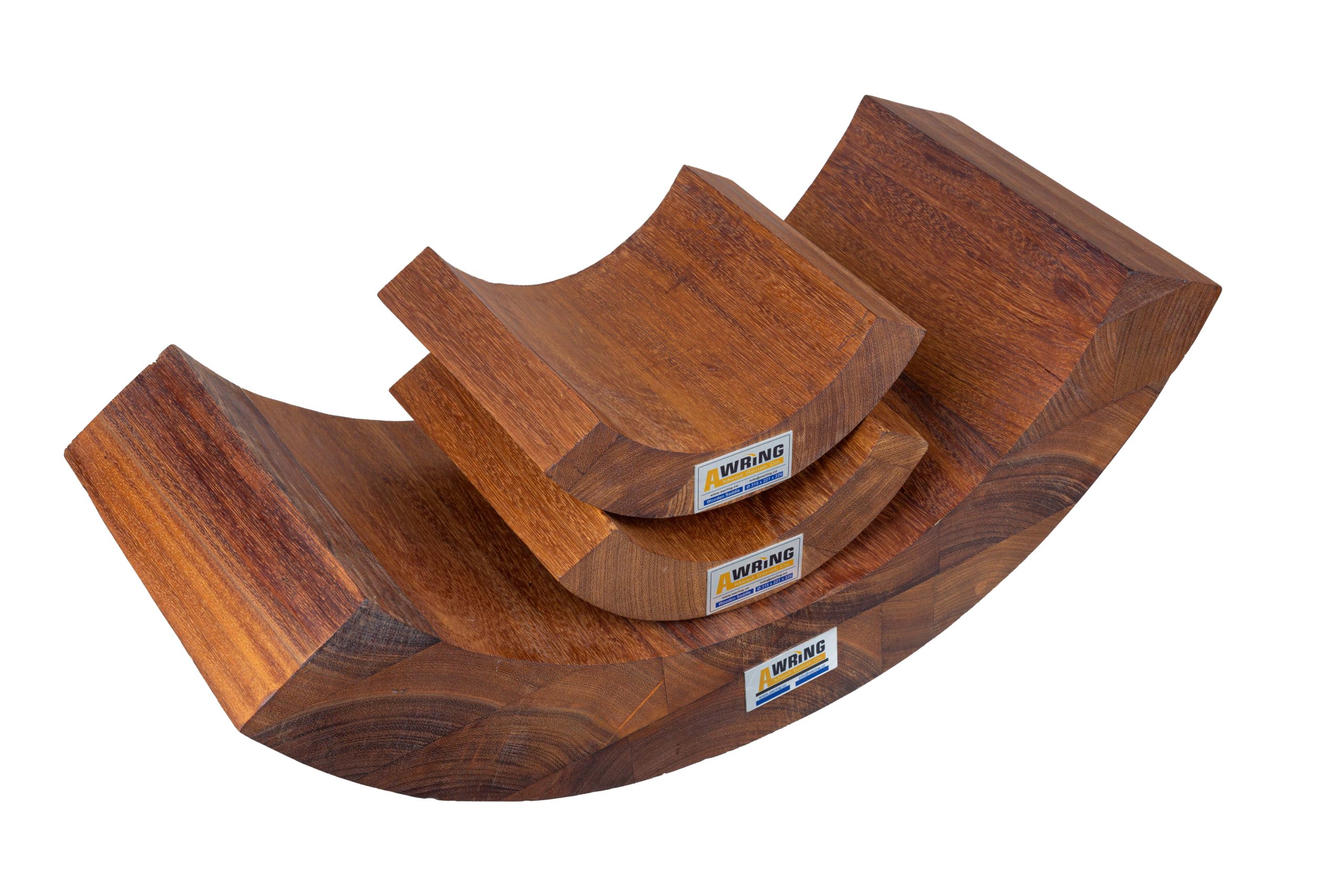
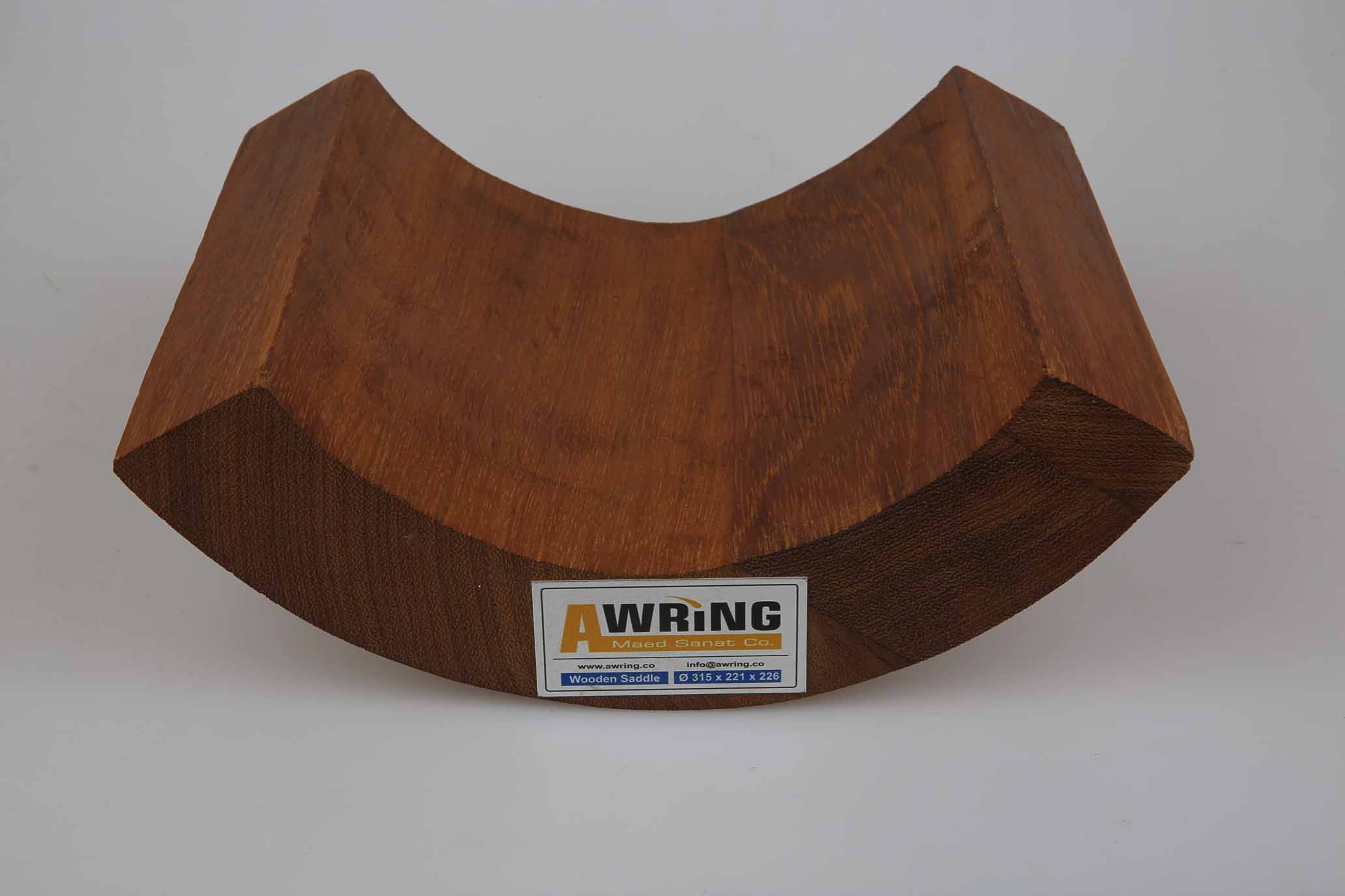
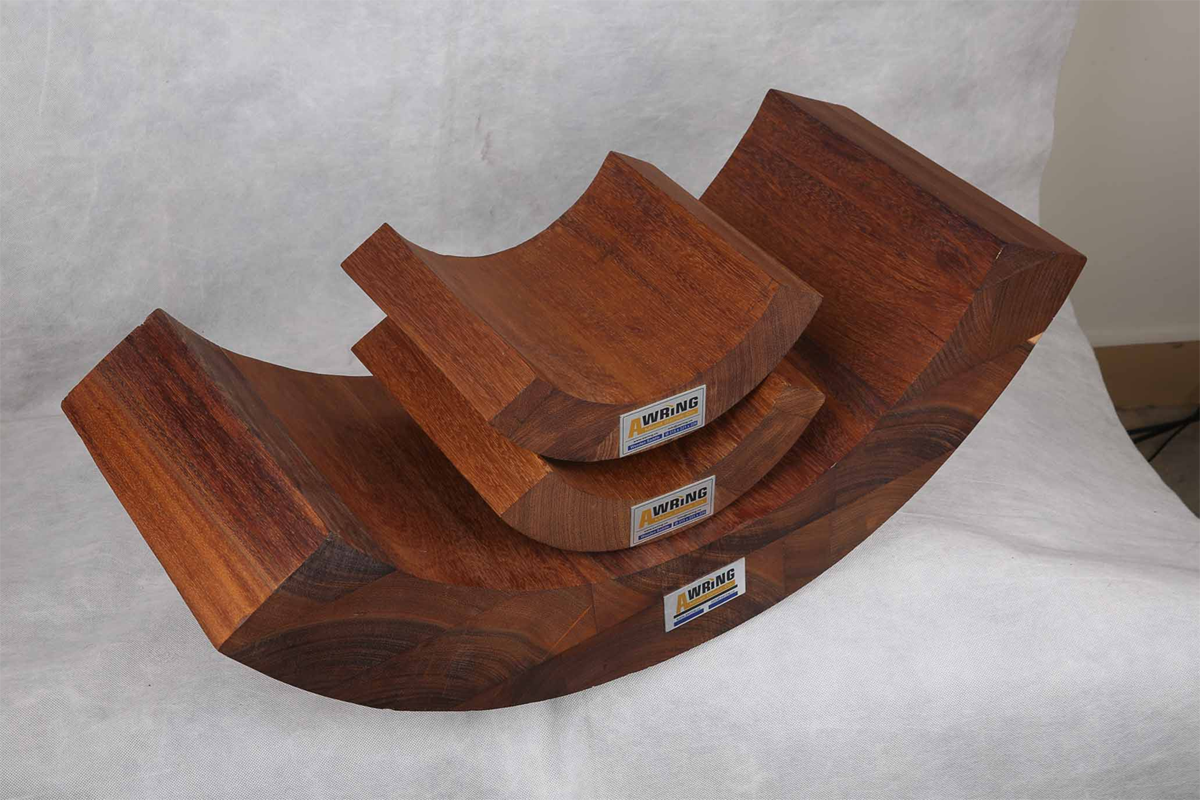
MAAD-WOOD® is an industrial product made from processed wood, introduced by the specialized
MAAD-WOOD® team as a technological and environmentally friendly solution.
The thermal treatment of wood inside vegetable oil is an eco-friendly method used to increase its service life.
The physical stability of MAAD-WOOD® raw materials is enhanced without negatively affecting their mechanical
properties and insulation performance.
Products manufactured using MAAD-WOOD® are applicable in various industrial uses such as blocks, supports, saddles,
beams, and isolating or separating columns.


Selected MAAD-WOOD® Deliverables:

To correctly identify and select the appropriate type of wood, it is necessary to review its characteristics and
specifications and choose the proper wood based on application and operating conditions.
The table below presents some indicators and information related to selected MAAD-WOOD® species.
| Common Name | Growth Region | Average Dry Density (kg/m3) | Janka Hardness (N) | Modulus of Rupture (MPa) | Modulus of Elasticity (GPa) | Parallel-to-Grain Compression (MPa) | Volumetric Shrinkage (%) |
| Iroko | Tropical Africa | 660 | 5610 | 6/87 | 38/9 | 0/54 | 8/8 |
| Teak | South Asia (native) | 655 | 4740 | 1/97 | 28/12 | 8/54 | 2/7 |
| Wenge | Central Africa | 870 | 8600 | 7/151 | 59/17 | 7/80 | 9/12 |
| Ash | Eastern North America | 675 | 5870 | 5/103 | 12/00 | 1/51 | 13/3 |
| Oak | Eastern United States | 755 | 5990 | 3/102 | 12/15 | 8/50 | 16/3 |
| Beech | Europe | 710 | 6460 | 1/110 | 14/31 | 0/57 | 17/3 |
| Spruce | Eastern North America | 435 | 2180 | 0/66 | 10/76 | 33/6 | 11/8 |
| Pine | Mediterranean Europe and Asia Minor | 475 | 2920 | 4/64 | 10/81 | 4/38 | 11/4 |
| Larch | Central Europe | 575 | 3290 | 0/90 | 11/80 | 0/52 | 12/5 |
| Ipe | Tropical America | 1100 | 15620 | 0/177 | 22/07 | 8/93 | 12/4 |
The design and manufacturing of MAAD-WOOD® are carried out based on the requirements of
ASTM-D143.
Additionally, depending on the application and usage type, other relevant standards listed below are applied
during the consultation and design stages.
| Standard Description and Criteria’s | Standard | Row |
| Physical and Mechanical Properties of Wood — Test Methods for Small Clear Wood Specimens — Part 1: Determination of Moisture Content for Physical and Mechanical Tests | ISO 13061-1:2014(EN) | 1 |
| Adhesives — Wood-to-Wood Adhesive Bonds — Determination of Shear Strength by Compressive Loading | ISO 6238:2018(EN) | 2 |
| Physical and Mechanical Properties of Wood — Test Methods for Small Clear Wood Specimens — Part 4: Determination of Modulus of Elasticity in Static Bending | ISO 13061-4:2014(EN) | 3 |
| Durability of Wood and Wood-Based Products — Use Classes | ISO 21887:2007(EN) | 4 |
| Adhesives — Wood-to-Wood Adhesive Bonds — Determination of Shear Strength by Tensile Loading | ISO 6237:2017(EN) | 5 |
| Physical and Mechanical Properties of Wood — Test Methods for Small Clear Wood Specimens — Part 15: Determination of Radial and Tangential Swelling | ISO 13061-15:2017(EN) | 6 |
| Solid Wood Parquet — Classification of Fir and Spruce Strips | ISO 5320:1980(EN) | 7 |
| Coniferous Wood Raw Parquet Blocks — Classification of Fir and Spruce Parquet Blocks | ISO 5333:1978(EN) | 8 |
| Wood-Based Panels — Determination of Swelling in Thickness After Immersion in Water | ISO 16983:2003(EN) | 9 |
| Wood — Sampling Methods and General Requirements for Physical and Mechanical Testing of Small Clear Wood Specimens | ISO-3129-700 | 10 |
| Wood — Determination of Moisture Content for Physical and Mechanical Tests | ISO-3130-941 | 11 |
| Wood — Testing in Compression Perpendicular to Grain | ISO-3132-416 | 12 |

