

Product Introduction
Oils or hydrocarbons are among the major contaminants in industrial wastewater, especially in refinery and petrochemical effluents. Oils may exist in water in three forms:
1- Free oil (dispersed oil droplets with significant size).
2- Emulsified oil (oil droplets 1–10 microns).
3- Dissolved oil (true molecular solution).
Free oils or greases at ambient temperature are immiscible and their shape, size, and density allow them to float on the water surface.
They can be separated using gravitational separation.
Emulsified oils behave similarly to free oils, but their droplet size is within the colloidal range. Due to their very small size, they cannot be easily floated to the surface.
The Dissolved Air Flotation (DAF) process is used for their removal.
Dissolved oils cannot be separated through physical processes and require biological or chemical treatment for removal.
The API Separator is typically the first and most important stage of wastewater treatment in oil refineries and related industries.
Its primary function is to remove most of the oil and suspended solids from refinery wastewater before downstream treatment processes.
In most industries, API is selected as a reliable primary treatment method for separating oil and solids.
Proper engineering design of API Separators reduces the load on downstream systems and improves overall treatment performance.
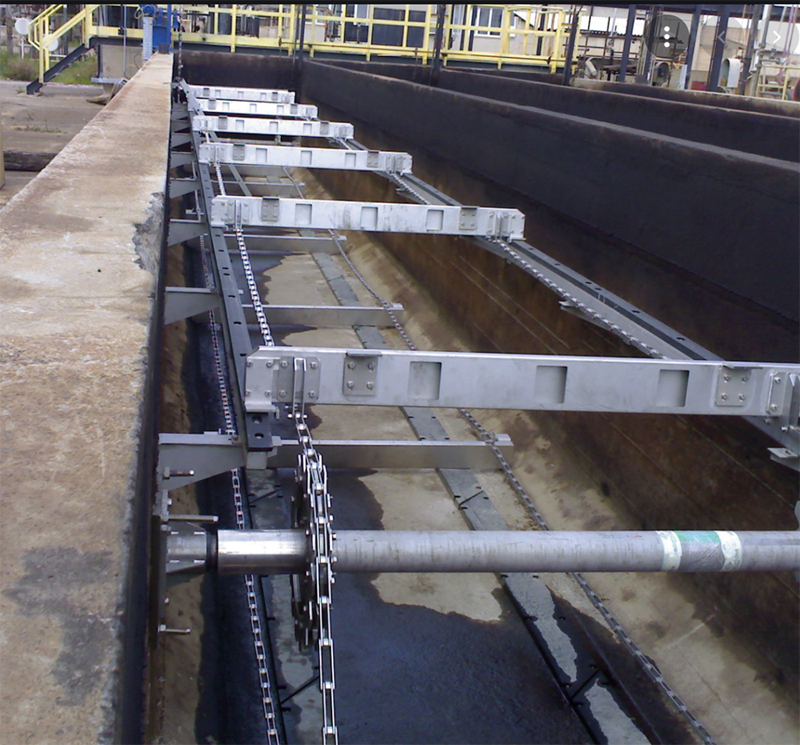
An API Separator usually consists of a shallow rectangular basin that provides sufficient retention time for most oils to float to the surface and be removed.
This slow and calm flow enhances gravitational separation efficiency.
The system operates based on density differences between water and oil, causing oil, grease, and hydrocarbons to rise to the surface, where they are collected by a surface skimmer.
At the bottom, heavier particles such as sludge and solids settle and are collected by a sludge scraper.
This method removes not only free and non-emulsified oils but also solid particles such as bolts, plastic sheets, metal pieces, and other large solids commonly found in industrial wastewater.
Several factors must be considered when selecting and designing oil–water separation systems:
It should be noted that API Separators cannot remove stable emulsified oils and have limited effectiveness on other pollutants such as COD, BOD, pH, and dissolved organic materials.

Applications:
API Separator Components
Depending on process requirements and design conditions, an API Separator may consist of various components.
The table below represents the general configuration and common equipment used in an API Separator.
| API Separator Main Parts | ||||
|
Remark |
Material |
Description |
Equipment | Row |
|
In hazardous areas explosion-proof motors must be used |
Acc. To Spec |
Electromotor-Gearbox |
Drive Unit |
1 |
|
Size and length depend on sump dimensions |
Polymeric / S.S |
Flights work as surface scrapers and sweep the settled-down sludge from the bottom of the sump |
Flight |
2 |
|
Size and length depend on total forces |
Polymeric / S.S |
The transmitter of drive unit force to flights |
Chain & Sprockets |
3 |
|
Polymeric / S.S / Conc |
The oil skimmer collects the surface oil and moves it out of the sump. It can be adjustable or fixed |
Oil Skimmer |
4 |
|